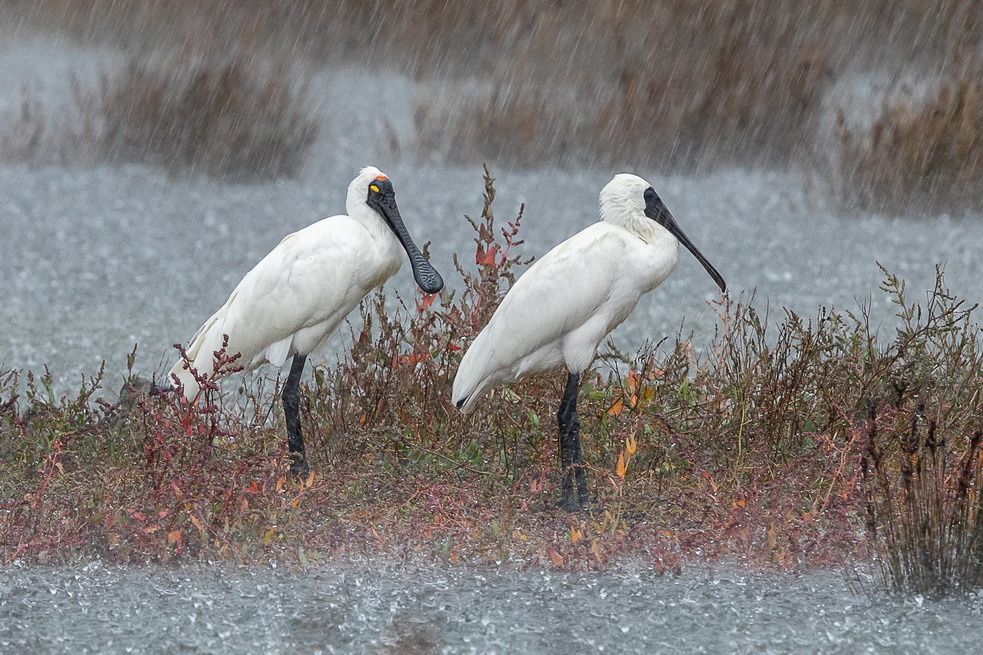
Royal Spoonbill

The royal spoonbill (Platalea regia), or kōtuku ngutupapa, is probably the most impressive bird to be seen in and around the Pāuatahanui Inlet. Usually found in flocks of 6 to a dozen individuals, a count of around 20 of these magnificent wading birds have been observed from time to time on our shores.
The royal spoonbill is easily recognisable. A large, bulky but long-legged, white bird (80cm tall) with a very long heavy-weight black bill, distinguished by its outstanding spoon-shaped tip. It can often be seen standing on one leg while, when flying, it always extends its head and neck straight out in front. During the breeding season the appearance is enhanced by long white plumes that grow from the back of the head and coloured patches that appear on the face, features that are used during the rituals used to find a mate.
Unlike its appearance, the spoonbill call is unremarkable, consisting of grunts, groans and hisses, with chew and cho calls made at the nest.
Often found alongside heron colonies, the royal spoonbill is a bird more closely related to the ibis, while its nearest immediate relative is a similar East-Asian bird, the black-faced spoonbill (Platalea minor).
Despite being seen around much of New Zealand, the royal spoonbill is not an endemic bird, occurring as it does all around the south western Pacific continents of Australasia and Asia, including Indonesia, Papua New Guinea and the Solomon Islands. It is one of six spoonbill species worldwide but the only one to breed in New Zealand.
It was unknown in New Zealand before the 19th century. Then, in 1861, the first appearance was recorded at Castlepoint when a single bird was observed. It is thought to have visited our islands from Australia, found the climate acceptable and stayed. For the next 90 years only a few casual visitors were seen but then, in 1948, the first breeding colony was observed at Okarito, South Westland. Population counts in 1977 still found that only 52 birds were estimated to be here but by 2012 (the last census taken) this number had risen to 2,360 birds.
The spoonbill is a wading bird, found in intertidal flats and the shallows of fresh and saltwater wetlands. It feeds and roosts in flocks. It is a carnivore, obtaining sustenance from a mix of fish, crustaceans and small insects.
Its feeding technique is unusual and distinctive. It uses the bill, held almost perpendicular to the water surface and slightly open, to slowly sweep in a broad arc from side to side while slowly walking forward as it does so. The spoonbill’s enlarged spoon-shaped beak forms a ‘hydrofoil’ — a kind of wing — flat on the bottom but convex on the top, like an aeroplane wing. It’s a shape that creates lift, causing a swirling vortex that disturbs the sediment, sucking invertebrates up into in the water column. Then, the tip of the beak contains vibration receptors that detect the presence of prey in the water and when an item is sensed it switches to an intensive sweeping of a small area. Snapping its bill shut on a prey animal it then lifts its head and lets the morsel slide down its throat.
Breeding begins in October when birds gather to carry out complex courtship displays culminating in monogamous pairing. Bowl-shaped nests are constructed in trees overhanging water in which 2 to 4 white eggs are laid from November to February, hatching 20-25 days later. With both parents sharing the duties, the chicks fledge after seven weeks, the young birds staying in the family group until dispersing to the usual wintering sites.
Royal spoonbills are sensitive to disturbance during the breeding season and are vulnerable to urban developments and recreational activities. It is important, therefore, to keep your distance when viewing the birds during this time.
Back in 2019, in an article for Dominion Post, wetland bird expert Murray Williams estimated that more than 100 of these birds nested in Wellington in the springtime, with a colony on Kāpiti Island that flock daily to the Pāuatahanui Inlet to feed. They can often be seen as a group, either at the mouth of the Horokiri stream, in the Wildlife Reserve or around Ivey Bay, each bird standing on one leg, just passing the time.